











Africa’s Trans-Saharan Gas Pipeline has received a boost following Algeria’s commencement of pipeline construction along its borderlines with neighboring Niger. President Abdelmadjid Tebboune made this disclosure recently amid European pressure to advance the project in the region.
The launch of a trans-Saharan gas pipeline across Niger is perceived to have been initiated following the easing of tensions between the two neighbors, as the Nigerien President, Abdourahamane Tchiani, paid its Algerian counterpart an official visit in Algiers.
“We agreed to launch the project to complete the trans-Saharan gas pipeline through Nigerien territory after the holy month of Ramadan,” Tebboune told a joint press conference in Algiers with his Nigerien counterpart, Abdourahamane Tchiani, as cited by the state news agency APS.
Diplomatic relations went south last April after Niger, along with allies Mali and Burkina Faso, recalled ambassadors following a dispute over alleged airspace violations involving military drones. Tchiani’s visit is seen as signaling an end to more than 10 months of diplomatic tension between the two countries.
According to Tebboune, the state energy company Sonatrach will now commence the construction of the pipeline that passes through Niger now that the diplomatic rows between the two neighboring countries have apparently been laid to rest.
“With this visit, we are ending an abnormal period characterized by coldness between the two countries, even though the two brotherly peoples continued to communicate with each other. We will preserve the friendship that has united us with Niger for generations,” Tebboune said.
In February 2025, the two countries, alongside Nigeria, signed an agreement to advance the development of the Trans-Saharan gas pipeline,
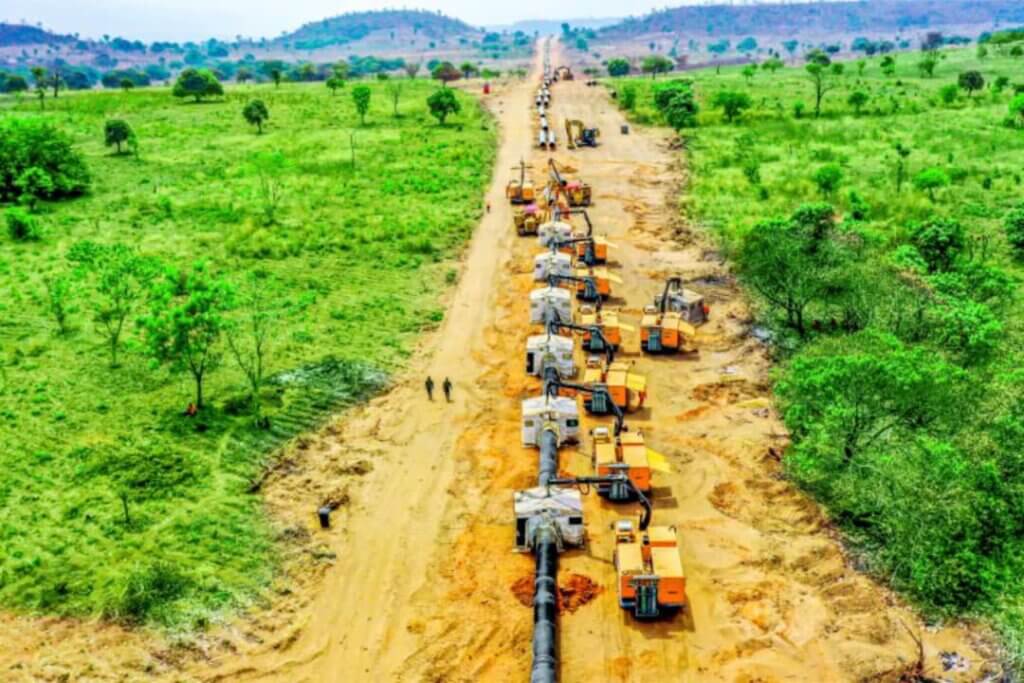
With an approximate length of 4,128 kilometres, including 1,037 kilometres in Nigeria, 841 kilometres in Niger, and 2,310 kilometres in Algeria, the $13 billion pipeline project is designed to transport up to 30 billion cubic meters of natural gas annually. The pipeline, initiated in 2022 to diversify European energy supplies, will be connected to existing infrastructure, providing a major alternative to Russian gas.
The 40’’ of 614 km Ajaokuta-Kaduna-Kano (AKK) pipeline acts as the initial, crucial, and domestic portion of the larger Trans-Nigeria Gas Pipeline (TNGP), which connects to the 4,128 km Trans-Saharan Gas Pipeline system extending through Niger to Hassi R’Mel, Algeria for export to Europe.
According to the Nigerian National Petroleum Corporation Limited, Monthly Report Summary for December 2025, the gas pipeline is 91% completed. AKK Mainline is completed, while the mainline welding works are ongoing as scheduled. Efforts are currently in top gear to complete the Intermediate Pigging Stations (IPS) and Block Valve Stations (BVS).
When completed, the Ajaokuta-Kaduna-Kano (AKK) gas pipeline in Nigeria is expected to transport up to 2.2 billion standard cubic feet of gas per day (2.2 Bcf/d). Some reports have indicated a potential maximum capacity of up to 3.5 billion cubic feet per day (3.5 Bcf/d) when fully operational
The major gas feed of AKK is from Obiafu-Obrikom-Oben (OB3) Gas Pipeline, which is at 96% completion. OB3 River Niger Crossing is completed, and all early works have commenced the Pilot Hole drilling. The project is on course to be completed as scheduled