






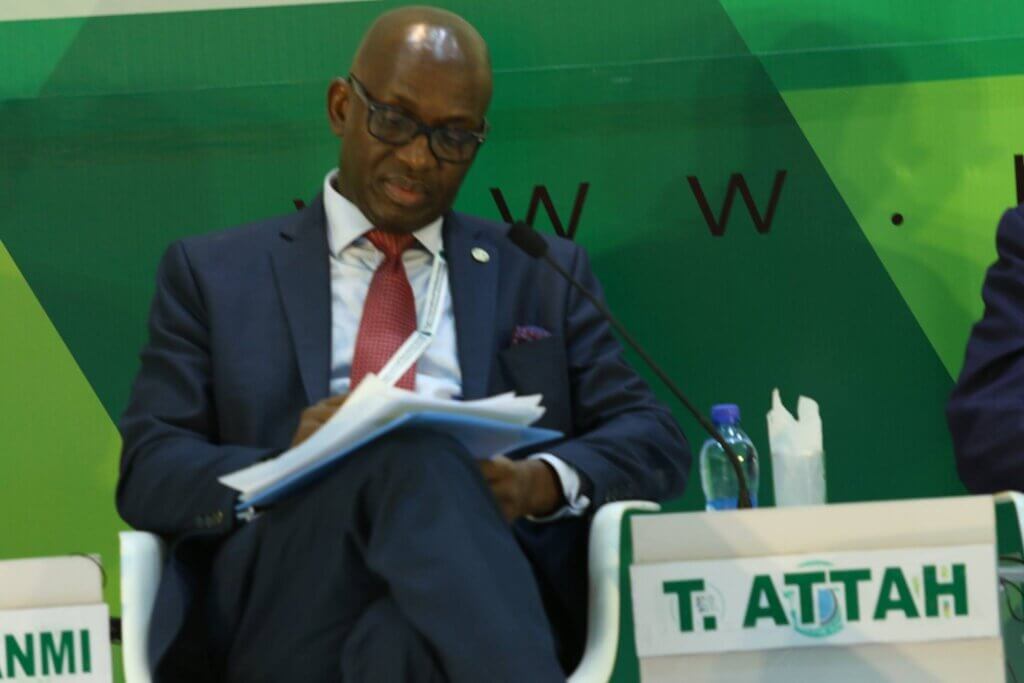
Managing Director of Renaissance Africa Energy Company Limited, Engr. Tony Attah has predicted that many indigenous oil and gas operators in Nigeria will, within the next decade, consolidate strategically and form consortia to take advantage of emerging opportunities.
He delivered a presentation at the Nigerian Content Academy Lecture on Thursday, entitled “Finding Funds for Effective and Efficient Local Content Initiatives – IPPG Perspective,” and projected that “five big Nigerian independent oil companies will emerge in the next 10 years in Nigeria. The future of this industry and business in the world is about collaboration.”
He lauded the significant growth in the operational and funding capacities of indigenous operating companies, resulting in their successful acquisition and operation of fields recently divested by some international operating companies (IOCs).
He observed that “when IOCs leave mature basins in other climes, international independents take over from them. But Nigerian independents take over in Nigeria. That transition is showing value today. More than 50 percent of Nigerian crude oil production is associated with independents. I see a future where more Nigerian independents would have to consolidate. Renaissance here, Seplat is here. The consolidation would have to be among the others to create the other three or five.”
He shared insight on the successful formation of Renaissance Energy by a consortium of four Nigerian and one international companies, namely ND Western Limited, Aradel Energy Limited, Waltersmith Petroleum Development Company Limited; First Exploration and Petroleum Development Limited, and Petrolin Trading Limited. He attributed the success of the deal to enduring collaboration, tenacity, and ambition among the founding companies.
Engr. Attah, a former Managing Director of Nigeria LNG Limited and Shell Nigeria Exploration and Production Company (SNEPCo) also outlined veritable funding mechanisms which players in the African energy sector could deploy to navigate global funding and operational challenges.
He dwelt exhaustively on Capital Markets/Stock Exchange Listing; Private Equity and Eurobond; Strategic Partnerships/Joint Venture Structures and International Oil Company (IOC) Carry Arrangements; Prepayment/Offtake Financing, and Bank Facility.
He underscored the need for “Bankability Criteria,” under which he listed proven reserves, financial covenant (minimum coverage ratio over the loan life), governance and transparency, stable production profile, hedging strategy (robust hedging to protect against downside price risk), operator track record, and proven Health Safety and Environment (HSE), uptime, and production execution track record.
He disclosed that industry players need an operational mindset anchored on a creedal mantra – ABC (Ambition, Belief (in that Ambition) and Courage) – as they set about exploring the different funding mechanisms available. He noted that “finding a solution to funding gaps is a big opportunity in itself,” while encouraging industry players to ensure that their organisations have structure, guarantee, and system.
He advised all indigenous players to guard against weak business models, excessive focus on projected profits, and weak balance sheets. “Without structure, governance and ambition, nobody will finance you,” he stated.
The Renaissance CEO expressed appreciation for the emergence of the African Energy Bank, established by the African Petroleum Producers’ Organisation (APPO) and the African Export-Import Bank (Afreximbank), with significant financial backing by the Nigerian Content Development and Monitoring Board (NCDMB), but called for more of similar initiatives, stating that the Bank is yet to attain the level of financial capability to meet the continent’s industry funding requirements.
“Accelerating Africa’s energy financing is a challenge,” he noted, pointing out that “equity financing is not everything,” and that the industry operator has to be clear about what he is also bringing into the business. His belief is that Africa needs to do business with Africa.
Engr. Attah declared that local content in Nigeria is “no longer a policy aspiration; it is a capital execution challenge,” while urging indigenous players to embrace the ABC creed and work toward achieving targets for growth and expansion, bearing in mind that “without adequate funding, newly acquired assets will under-invest.” According to him, “You need the mindset of creating value; money will come,” as “capital follows value.”
In the Question-and-Answer segment, the former Director of the Nigerian Content Academy, Dr. Ama Ikuru, remarked that independents (indigenous upstream operators) have been remiss in fulfilling their obligations to their vendors, repeatedly failing to pay them when due. To that, Engr. Attah responded by advising independents against acts that would diminish their brand. He urged them to always fulfill contractual obligations. “Your business will not grow if you keep owing,” he warned.
The former Vice Chairman of the Petroleum Technology Association of Nigeria (PETAN) and Executive Chairman of Radial Circle Group, Engr. Ranti Omole, inquired what Renaissance and other successful Independents could do to boost prospects of growth among service companies. The Guest Lecturer assured of rewarding business engagements.
Professor Babs Oyeniyi, who participated from Edinburgh, United Kingdom, wondered why Nigeria’s oil and gas industry appears stuck with old, retired industry employees, continually inviting them to provide critical services. Engr. Attah attributed the trend, which he described as worldwide, to shifting interests and attention as youths today are moving into areas of Artificial Intelligence/Robotics, and fewer and fewer technically competent hands in the country.
Earlier in her opening remarks, the General Manager, Nigerian Content Academy, NCDMB, Ms. Doris Opuwari, had noted that funding constraints have for so long constituted barriers to growth and expansion among indigenous players in the industry, expressing hope that the Guest Lecturer of the day, Engr. Attah was eminently qualified to point the way forward.
In a goodwill message/closing remarks, the Director, Corporate Services, NCDMB, Dr. Abdulmalik Halilu, thanked Engr. Attah for a thoroughly researched and exhaustive work on the subject which he believed would be most beneficial to industry players. He also thanked the nearly 200 participants at the zoom event for their interest and sustained attention.