



1. Introduction
Good evening.
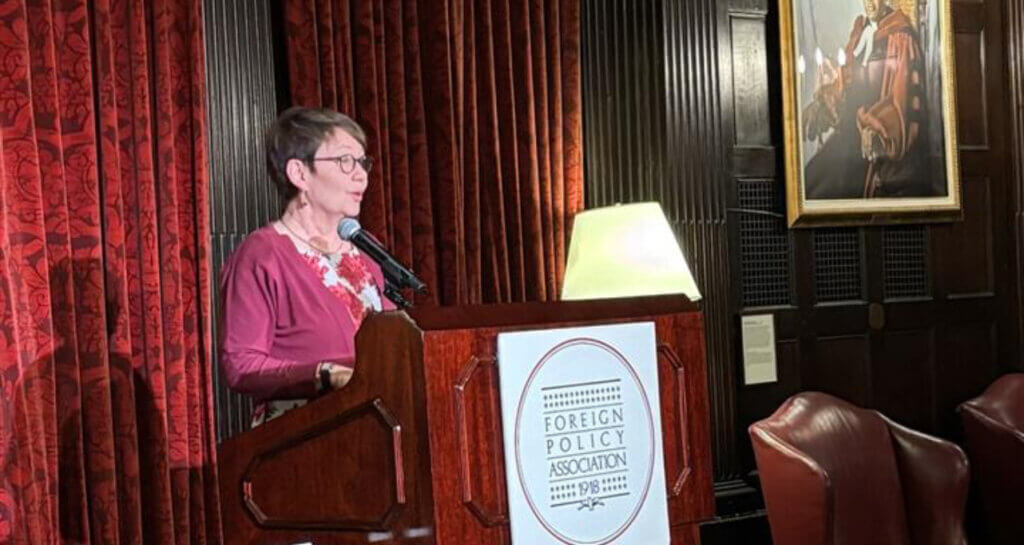
It is a great honour to be here tonight and to accept this medal from the Foreign Policy Association.
My American journey began many years ago, when I enrolled for a summer programme at the Kennedy School of Government. It continues this week, as President of one of the world’s multilateral development banks, with a visit to Washington – and a stop here in New York.
So here we are, at the Harvard Club of New York, as guests of the Foreign Policy Association. An organisation founded, in part, to support the creation of one of the world’s first multilateral bodies: the League of Nations.
That League ultimately failed.
And it failed in no small part because of the United States’ refusal to join.
But the spirit inspiring it did not.
The idea that countries are stronger when they work together endured. And it lives on, not least at the EBRD, the bank which I have the privilege to lead.
Today, however, that idea is under pressure again – perhaps as never before.
We can all spot the paradox.
Global challenges are more transnational than ever.
Yet confidence in shared solutions is clearly weakening.
This imposes a special responsibility on a multilateral development bank such as ours. A responsibility to show that working together continues to deliver results for all individually and for the common good.
The EBRD was set up at the at the end of the Cold War, through the efforts of G7 and Europe, to help build open, market economies through investment in the private sector.
We have 77 national shareholders, with different interests and different views. But they are actively engaged in what we do and empower us to do our work in the countries where we invest.
That matters. Not least because the world we live in has become more volatile, more fragmented, and more demanding.
2. The multilateral system in an era of crisis
This evening, I want to share a few reflections on what today’s crises mean for the multilateral system.
Crises themselves are not new. In our lifetimes, we have lived through wars, financial collapses, oil shocks – and a global pandemic.
What has changed is how these shocks travel.
Our economies are now so interconnected that regional crises quickly go global, carried across borders via energy markets, trade routes, financial systems and supply chains.
We see this in the Middle East, where under some scenarios, the crisis could reduce global growth by at least 0.4 percentage points — and push inflation up by more than one percentage point.
And this is not only about energy. Higher fertiliser prices increase the cost of food. Disrupted shipping routes affect trade and tourism.
Heightened risk aversion raises borrowing costs – precisely where fiscal space is already limited.
All of this is unfolding in economies already weakened by successive shocks.
—
In this world, long held assumptions are being questioned:
about open markets, fair competition, and shared rules as the best path to growth, efficiency and resilience.
Acting alone may feel safer. But it is often more costly.
Widening inequality, climate shocks and forced displacement do not stop at national borders.
When risks are not managed collectively, they are simply transferred – through markets, migration, and financial instability – until everyone bears the cost.
And in a world of weaker growth, tighter financing and elevated debt, delayed or poorly designed responses leave lasting scars.
3. The EBRD’s perspective
What does that mean for institutions such as the EBRD?
Rebuilding trust in open, rules based systems does not mean pretending globalisation worked perfectly.
It means recognising where it fell short – and addressing its perceived failures.
It means ensuring that countries and communities can see real benefits from cooperation.
This is where multilateral development banks have a vital role to play.
Addressing market failures is central to our mandate.
As international financial institutions with AAA ratings, we can mobilise capital quickly – and deploy it where others can’t.
• We can invest in riskier projects.
• We can deliver systemic impact
• And we can do so over the long term.
We also operate counter cyclically — scaling up when others pull back.
And at the EBRD, with our focus on the private sector, we work on the ground, close to our clients, with a detailed understanding of the challenges they face.
That mix — financial strength, local presence and long term commitment – is what allows us to be especially effective when crises hit.
4. Ukraine
For us, as the largest institutional investor in Ukraine, Russia’s brutal war
has become a defining test case.
When the full scale invasion began, our immediate priority was supporting Ukraine’s economic survival.
We focused on:
- Providing liquidity to key utilities and municipalities to keep the lights on and supply essential services.
- Sustaining private sector companies and providing trade finance to keep the economy going.
Since the start of the war, we have deployed close to 11 billion dollars, adapting our instruments to conditions where conventional risk frameworks no longer applied.
But this was never just about emergency support. Even in wartime, we continue to work on reforms to lay foundations for the reconstruction:
- From capital market development
- To improving state-owned enterprise governance
- To veteran reintegration
All to support effective recovery and build back better when the time comes.
Our shareholders recognise that this two-pronged approach works.
The overwhelming majority — including the whole of the G7 — recently agreed to a four billion euro capital increase to strengthen our ability to support Ukraine while continuing to deliver across all our economies.
5. Middle East
Ukraine shows what multilateral development banks can do in times of extreme stress: preserve economic functioning, sustain reform even under fire, and keep open the path to recovery.
And we are already using lessons learned in Ukraine to shape our response in the Middle East.
Just last week, we have announced a five billion euro response — covering Jordan, Lebanon, the West Bank and Gaza, Iraq, as well as Egypt, Turkiye, Armenia and Azerbaijan.
Through it, we are helping to reduce immediate economic and social impacts of the crisis and lay long-term foundations for recovery.
We do so by:
- contributing to the stability of financial systems and trade flows.
- supporting energy and food security.
- providing liquidity to firms and utilities facing sudden shocks.
- combining finance with policy engagement and institutional support.
- And continuing to invest in people – in skills, opportunity and inclusion.
6. Effective crisis response
Let me leave you with the three practical rules for effective multilateral crisis response.
First: preserve the economic core.
In a true crisis, the priority is not rebuilding – it is preventing collapse.
If firms disappear, if banks stop lending, if essential services fail, recovery becomes slower, costlier and more fragile.
This is economic life support.
Second: treat risk, not just capital.
In modern crises, money is often not the binding constraint.
Risk is.
Capital exists. But uncertainty drives it away.
MDBs must absorb and transform risk — through guarantees, insurance and risk sharing — to lure private investment back.
Third: move fast – and take institutions with you.
Speed matters. But so does capacity.
Effective crisis response combines rapid financing with policy support that strengthens institutions for recovery.
Acting fast outside institutions weakens impact.
Acting perfectly but too slowly undermines relevance.
7. Conclusion
So let me conclude.
At institutions such as the EBRD, multilateralism is very much alive.
To echo Mark Twain, the reports of its death are greatly exaggerated.
A multilateralism which is pragmatic, disciplined, and focused on demand and results can – and will – continue to deliver.
Not just at the EBRD.
But across the system.
In a world as interconnected as ours, it has to.
I am confident that, working together, we can continue to make a meaningful difference — as we have done before.
This medal therefore means a great deal to me.
Not only as a personal honour, but as a symbol of continued faith in international cooperation – and of our shared responsibility to make it work.