
















The Zabazaba development will ensure production at 150,000 BOPD for the first few years, while the Etan tie-back will maintain production for the remaining 13 years. Oil production and gas sales will start in 2029 for a period of 13 years, with estimated 417 MMSTB and 448 BSCF, respectively, at development and operating costs of US$10.3 billion and US$7.7 billion, respectively. The estimated UTC was US$36/ BOE.
ZABAZABA FIELD
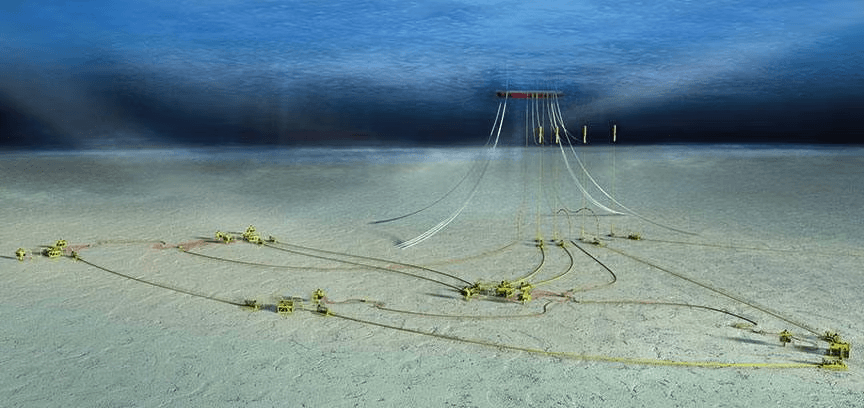
Zabazaba (PML 103) was discovered by an exploration well in April 2006 and appraised/matured by three (3) appraisal wells, which encountered three (3) reservoir systems. The development plan for Zabazaba field is premised on a 150,000 BOPD capacity, FPSO processing facility centrally positioned with respect to the overall subsea configuration of the field, with a total of 22 wells planned in 2 phases.
Phase 1 will comprise 11 oil producers and 5 water injectors, while Phase 2 will comprise 4 oil producers and 2 water injectors. The gas will be exported through a 130 km gas export pipeline to OGGS to commercialise the gas via NLNG Bonny and also meet the no routine flaring requirement of the PIA 2021. The Zabazaba FDP aims to develop the three reservoir systems in the Zabazaba field to recover about 320 MMSTB of oil and 392 BSCF of gas.
The primary objective of the FDP is to economically develop and maximise the oil and gas reserves discovered, at a CAPEX of about US$7.3 billion. The field development is fully supported by comprehensive data sets from seismic, drilled exploratory/ appraisal wells, production tests, and production performance data benchmark from other deep-water fields in the region (Bonga and Abo fields). A total of 15 oil-bearing reservoirs have been discovered in the field.
So far, no NAG reservoir has been discovered. The FDP is expected to recover 320 MMSTB of oil at a peak rate of 150,000 BOPD and 391 BSCF of gas at a peak rate of 200 MMSCF/D with 22 wells (15 oil producers and 7 water injectors from 15 reservoirs for 20 years. The expected Associated Gas (AG) to be recovered from this development is 390 BCF, with a peak daily production of about 200 MMSCF/D. Some fractions of the gas will be utilised for fuel while the rest will be sent to the OGGS for onward transportation to NLNG Bonny for export.
ETAN FIELD
Etan field (PML 102) is located in the eastern part of OPL 245 and was discovered within the same East play by 2 wells drilled February 2005 and another drilled October 2006 and later wells. The wells encountered two (2) reservoir systems. Etan field is structurally separated from Zabazaba by Songu Ridge area.
Etan is composed of two main areas (Etan Main and Etan West). The field development approach foresees a phased development with a tie-back of Etan field production to the Zabazaba facility for commercial viability. The development plan for the Etan field foresees a subsea configuration of the field with 10 wells (6 OP + 4 WI) planned in 2 phases.
Production from the Etan field will keep the FPSO full at about 150,000 BOPD as that from Zabazaba begins to decline. Produced gas will be evacuated via an export line from the start of production, ensuring zero routine gas flaring in line with regulatory requirements. The FDP is aimed at developing the 2 reservoirs systems in the Etan field to recover about 151 MMSTB of oil and 133 BSCF of gas.
The primary objective of the FDP is to economically develop and maximise the oil reserves discovered, at a CAPEX of about US$3 billion. The field development is fully supported by comprehensive data sets from seismic, drilled exploratory/ appraisal wells, production tests, and production performance data benchmark from other deep-water fields in the region (Bonga and Abo fields).
A total of ten (10) oil bearing reservoirs have been discovered in the field. So far, no NAG reservoir has been discovered. All the reservoirs are undeveloped. The FDP is focused on the development of the hydrocarbon bearing reservoirs in the field for maximum recovery of hydrocarbons for 20 years and beyond.
Culled from NUPRC Upstream Gaze: FROM GLOOM TO BOOM: HOW OPL 245 SIGNING CHANGES THE PETROLEUM LANDSCAPE – By Engineer Enorense Amadasu, FNSE, Emmanuel B. Mac Jaja, and Dr. Emmanuel E. Okoro